
 Argentina
 Brazil
 BVI
BVI Canada
 Chile
Chile Colombia
 Costa Rica
 Curaçao
 El Salvador
 Guatemala
 Honduras
 Mexico
 Nicaragua
 Panama
 Peru
Peru Uruguay
 USA
USA Germany
 Luxembourg
 South Africa
 Spain
Spain Switzerland
 The Netherlands
 United Kingdom
 Hong Kong
 India
India New Zealand
 Singapore
 Turkey
 Armando Hernandez MBA, CPA
Most companies do not fail when they go global.
They lose coherence. Slowly. Quietly. Until nothing works.
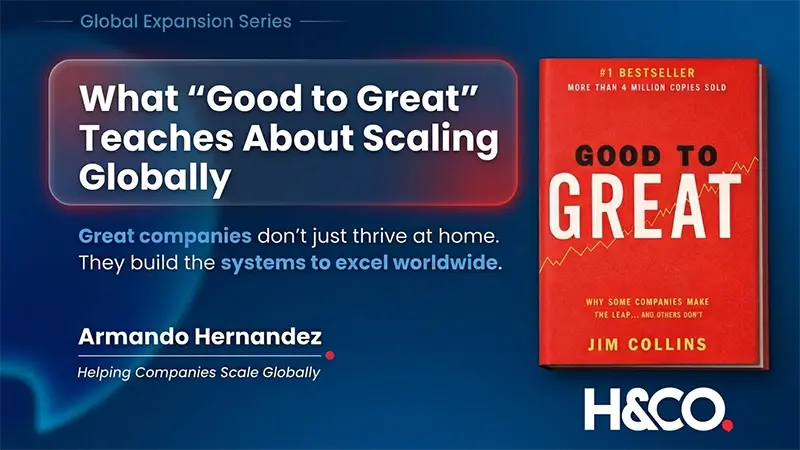
Jim Collins identified exactly why in Good to Great. And every principle he found applies directly to founders building across borders today.
I have watched brilliant founders with exceptional products enter new markets and fail. Not because the opportunity was wrong. Because they stopped operating with the same standards that made them great at home.
I have also seen ordinary companies build operations that became the foundation of their entire global strategy. The difference was never talent or capital.
It was always the principles.
Here is what Collins found, and what I have seen with my own eyes.
First Who, Then What
Jim Collins argued that great leaders do not start with a vision and then find people to execute it. They start with the right people, and then they decide where to go.
In global expansion, this is not a philosophy. It is a requirement.
I have seen companies enter new markets with a clear strategy and the wrong team. The strategy looked right on paper. Within months, it collapsed. Not because the opportunity was wrong, but because the people on the ground did not have the judgment, discipline, or cultural awareness to execute in a complex environment.
The right plan with the wrong people is not a plan. It is the most expensive mistake you will make in slow motion.
Global companies are not built on strategy alone. They are built on people who can operate in uncertainty, make decisions without perfect information, and represent your business in markets you are not present. Because tolerating the wrong people in a global operation is not just a culture issue. It is an operational risk that compounds across time zones, currencies, and regulatory environments.
Every person you hire either strengthens or weakens the system.
Get the right people first. Everything else follows.
Who is the person you kept too long in a global role, and what did it cost you?
The Hedgehog Concept
Every new market looks like an opportunity. That is the trap.
Early in our global expansion, we were approached to enter a business line adjacent to our core. The numbers looked attractive. The market was real. But it was not what we were built to be the best at. We said no. A year later, a competitor took that opportunity and spent two years recovering from the distraction it created.
Collins called this the Hedgehog Concept. The intersection of three things: what you can be the best in the world at, what you are deeply passionate about, and what drives your economic engine. Not two of the three. All three.
My partner Emilio Alvarez has built one of the most respected CPA practices in the construction industry, recognized nationally as one of the best in his field. He always says: "the riches are in the niches". Six words that explain the Hedgehog Concept better than most business books do.
Global expansion amplifies everything. New markets. New clients. New verticals. Everything looks like growth. But without the discipline to stay inside your Hedgehog Concept, expansion does not create scale. It creates dilution. You become present in many places, but strong in none.
In a global business, focus is not a limitation. It is a survival strategy.
What is the opportunity you said no to that turned out to be the right call?
Confronting the Brutal Facts
Collins called it the Stockdale Paradox. James Stockdale survived years as a prisoner of war by holding two truths at the same time: a strong belief that he would prevail and a clear understanding of his brutal reality. Great companies operate the same way.
Most founders are optimists by nature. But unchecked optimism in a global operation is not a strength. It is a liability. I have sat across the table from leaders who knew their market entry was underperforming and still did nothing about it.
When the numbers, the brutal facts, tell you that you are overstaffed, time is not your ally. Waiting only makes the problem bigger and the outcome worse. Make decisions based on what is real, not on the hope of what could happen.
In global business, brutal facts arrive faster and hit harder. The companies that act on them are the ones that succeed. Over time, I have learned that the best decisions come from one place. Look at the brutal facts. Then decide. Not from hope. Not from pressure. From what is actually in front of you.
I always tell my team the same thing. Look at the brutal facts and make the decision from there.
I have always managed my company by numbers. On the first day of each month, the team has the results from the prior month. Then we look at the brutal facts and decide what to do in the current month. If sales were down, what do we do differently this month. If expenses went up, where do we adjust now.
In our case, the numbers are our brutal facts. We make decisions from them, not from hope.
What number were you avoiding looking at, and what changed when you finally did?
Culture of Discipline
When we expanded into Mexico, we acquired 51 percent of a company run by a husband and wife. Great people. Solid business. But two years in, we could not move the needle on sales. Not because the market was wrong or the people were incapable.
The culture was simply not compatible with ours. The way decisions were made, the way standards were applied, the way the business was run day to day was different in ways that no contract could fix. We eventually asked the sellers to buy our interest back. An honest recognition that cultural alignment is not something you negotiate after the fact.
We went back into the same market and acquired a second company. Better cultural fit from the start. The results have been different ever since.
Collins argued that discipline is not a set of rules. It is a culture. And culture does not bend to meet yours just because you wrote a check.
The companies that struggle internationally lower their standards because a local market feels different, or they acquire partners whose culture quietly pulls them in a different direction.
Discipline does not travel on its own. It must be built into every system, every hire, and every partnership long before you sign anything.
Where did your standards slip when you entered a new market, and how did you catch it?
Technology as Accelerator, Not Creator
I once watched a global financial company invest over ten million dollars to build proprietary payment software for a new market. The engineering was world class. The product worked exactly as designed. But the market had its own entrenched payment behaviors that the software did not account for.
After years of trying to force adoption, they abandoned the platform and licensed a third party solution that already understood the local market. Ten million dollars to learn what was already available for a fraction of the cost.
Collins found that great companies were not technology pioneers. They used technology to accelerate momentum that already existed, not to create momentum that did not.
Technology does not fix a broken strategy. It exposes it faster. In global business, the question is never which technology to adopt. It is whether you have something worth accelerating in the first place.
What tool did you buy to solve a strategy problem, and how did that turn out?
The Flywheel
Collins described how great companies build momentum through consistent, disciplined effort over time. No single moment. No dramatic transformation. Just the right actions, repeated with discipline, until momentum sustains itself.
The flywheel is simple. Small, consistent actions compound over time and create momentum. For some companies it takes five years. For others, twenty. I have seen companies grow 5% year after year, then suddenly accelerate and double in size within two years. That is the flywheel effect. I have seen it in my own company.
New markets do not open overnight. Regulatory relationships take time. Brand trust takes time. Most companies stop before the flywheel gains momentum.
Early in my career, a global and successful entrepreneur from Ecuador, Mr. Manuel, told me that the hardest thing for an entrepreneur is patience. At the time, I did not fully understand it. Today, it is clear. Without patience, you may never see the result of your own hard work.
Patience is not passive. In global business, patience combined with disciplined execution is one of the most powerful forces a founder has.
What is the moment you almost stopped pushing before the flywheel kicked in?
Level 5 Leadership
Collins described Level 5 leadership as the highest level of leadership capability. It is a combination that looks contradictory. Personal humility and professional will at the same time. These leaders are ambitious, but not for themselves. They are ambitious for the success of the organization.
They are not loud or driven by recognition. They are focused, disciplined, and consistent. They make tough decisions when needed. They take responsibility when things go wrong and give credit to others when things go right. They build teams, systems, and successors that allow the company to endure beyond them.
It is rare to find a leader with all these characteristics. But these are the leaders you want running a company, especially in a global environment.
Level 5 leaders operate differently. They stay focused on the purpose, the standards, and the long term outcome. They make decisions based on what is right for the company, not what benefits them personally.
In global business, leadership is not about visibility. It is about responsibility. The leaders who combine humility with the discipline to execute are the ones who build companies that last.
Who is the quietest leader you have ever worked with, and what did they build?
The Standard That Never Moves
Global expansion does not reward the most talented founders. It rewards the most disciplined ones.
Get the right people before you decide where to go. Stay focused on what you can truly be the best at. Look at the numbers every month and make decisions from what is real, not from what you hope. Build a culture that holds its standards in every market, not just the ones you are watching closely. Use technology to accelerate what already works. Push through the slow years before the flywheel gains speed. And lead with enough humility to build something that outlasts you.
I have seen brilliant founders fail globally because they ignored one of these. I have also seen ordinary founders build extraordinary companies because they executed all of them with patience and discipline.
The principles have not changed in twenty years. They will not change in the next twenty.
The only question is whether you are honest enough to apply them to your own business right now?
Looking forward to learning and building great companies together