


 Argentina
 Brazil
 BVI
BVI Canada
 Chile
Chile Colombia
 Costa Rica
 Curaçao
 Guatemala
 Honduras
 Mexico
 Nicaragua
 Panama
 Peru
Peru Uruguay
 USA
USA Germany
 Luxembourg
 South Africa
 Spain
Spain Switzerland
 The Netherlands
 United Kingdom
 Hong Kong
 India
India New Zealand
 Singapore
 Turkey
CPA & Advisory Excellence
ENTITY
CONTROL.
GLOBAL SCALE.
Comprehensive legal entity oversight for corporate teams and executives navigating global regulatory landscapes.


01.
The
Introduction
Entity management is the ongoing process of maintaining and overseeing a company's legal entities to ensure compliance with local, regional, and global regulatory requirements.
Entity management services are the foundation of successful global operations, encompassing the oversight and administration of legal entities for any enterprise—including corporations, subsidiaries, and affiliates—as well as joint ventures.
This guide is intended for corporate legal teams, compliance officers, and executives responsible for managing global legal entities. Effective entity management services are critical for organizations navigating complex regulatory environments and pursuing international growth.
By maintaining accurate records of ownership, directors, and officers, and ensuring ongoing compliance through timely filings and renewals, businesses can reduce risk, streamline processes, and drive strategic growth.
Modern technology, including entity management systems and automation, is transforming how legal and compliance teams manage complexity and streamline corporate compliance operations without increasing manual effort. Comprehensive entity management provides the oversight needed to protect legal entities, maintain good standing, and support governance at every stage of the business lifecycle.
Executive Summary
| Entity management services provide the ongoing oversight and administration of legal entities, ensuring compliance with regulatory requirements, supporting corporate governance, and enabling organizations to expand internationally with confidence. Core functions include: | Compliance with global regulations Governance framework support Risk reduction through filings International expansion facilitation |
Essential for Strategic Growth
Lifecycle Management
Global Entity Lifecycle
This section covers the central administration of entities from incorporation to eventual dissolution, ensuring every step meets local regulatory requirements.
Entity Formation & Incorporation
Creating and establishing companies across multiple jurisdictions and countries, with a focus on understanding local market conditions, following country-specific rules, and ensuring compliance as organizations are expanding into new markets.
At H&CO, we transform this process into a seamless global expansion. We act as your on-the-ground experts, handling the regulatory heavy lifting and legal structuring so you don't have to navigate unfamiliar frameworks alone. Partner with us to accelerate your market entry, eliminate compliance friction, and build a secure, fully optimized corporate foundation from day one.

Regional Insight: Latin America
| Setting up a legal entity in Latin America can involve complex incorporation procedures that vary significantly from country to country, even in regions that encourage foreign investment. Companies often face challenges such as the requirement for local representation, which mandates having locally based legal representatives to handle various procedures. Tax registrations in Latin American countries can be particularly burdensome and time-consuming, often requiring in-person actions despite some processes being digitized. |
Registered Agent
Legal seat and official representation for receiving government documentation.
Dissolution
Management of orderly entity closures and fulfillment of final compliance mandates.
Directorship
Provision of local directors and officers to meet substance and governance requirements.
Governance Framework
Corporate
Secretarial &
Governance
Statutory Compliance
Maintenance of corporate books, shareholder registers, and minutes. Organized records significantly accelerate the due diligence process for mergers, acquisitions, or funding rounds. This includes management of annual renewals and mandatory filings with regulatory bodies.
Board & Shareholder Support
Organizing board meetings, quorum preparation, and drafting resolutions. The board of directors has a direct influence on governance decisions and holds significant power in shaping the company’s strategic direction.
"Sourcing board members with expertise relevant to the company’s industry, as well as diverse outside perspectives, can enhance governance and decision-making. Good governance practices ensure the interests of employees and customers are considered, building trust and supporting long-term success. For example, implementing robust entity management services can streamline governance reporting and prevent failures seen in cases like Enron."
Ownership & Disclosure

Corporate
Transparency
"Regulations such as the U.S. Corporate Transparency Act and the EU’s Anti-Money Laundering directives require organizations to identify and report their ultimate beneficial owners, helping to prevent tax evasion, money laundering, and other financial crimes."
Accurate and up-to-date beneficial ownership records are essential for compliance, risk management, and governance. By prioritizing transparency, organizations can reduce risk, avoid reputational damage, and demonstrate accountability to regulators through regular audits.
Registered Agent Component
A registered agent acts as the official representative for receiving legal and regulatory communications. This includes filing annual reports, paying necessary fees, and staying updated on local regulations in countries such as the Cayman Islands.
Private Wealth
Fiduciary & Trust
Trust administration
Private foundations
Succession Planning
Asset protection
Specialized fiduciary services integrated to strengthen
asset protection and succession planning for clients.
asset protection and succession planning for clients.
Modern Compliance
Regulatory
Compliance
Critical compliance service offerings are essential for risk mitigation, adherence to international fiscal transparency standards, and ensuring your entity management strategy is effective across every country where you operate.
The 2024 Corporate Transparency Act
"Requires certain legal entities to report beneficial ownership information to FinCEN, including details on individuals who own or control at least 25% of the entity."
Technology's
Role
Technology is transforming entity management by automating compliance tasks, centralizing governance documents, and providing real-time access to entity status and operations. Automation reduces manual effort, minimizes errors, and ensures timely filings.
"Centralized dashboards in entity management services provide real-time visibility into an organization’s global health."
Strategic Growth
Benefits of
Management
Enhance Corporate Governance
Improve Risk Management
Support Strategic Growth
Increase Transparency
Global Expansion
"Expanding into new countries presents unique challenges, from navigating local regulations to establishing new legal entities. Entity management is critical for organizations pursuing global expansion, as it enables: Centralized Oversight, Regulatory Compliance, Efficient Processes, and Risk Management."
Strategic Growth Decision Making
A strong entity management foundation empowers organizations to make strategic decisions that drive business growth and strengthen overall governance.
Execution & Success
Best Practices & Specialized Support
Post-Incorporation Support
Post-incorporation procedures such as obtaining Tax IDs and business licenses.
Bank Account Opening
Assistance in opening and maintaining corporate banking relationships with time zone alignment.
Escrow Services
Asset custody in commercial transactions to guarantee security for all parties.
Entity Management Checklist
- Implement Robust Systems
- Maintain Accurate Records
- Establish Clear Policies
- Provide Training Support
- Conduct Regular Audits
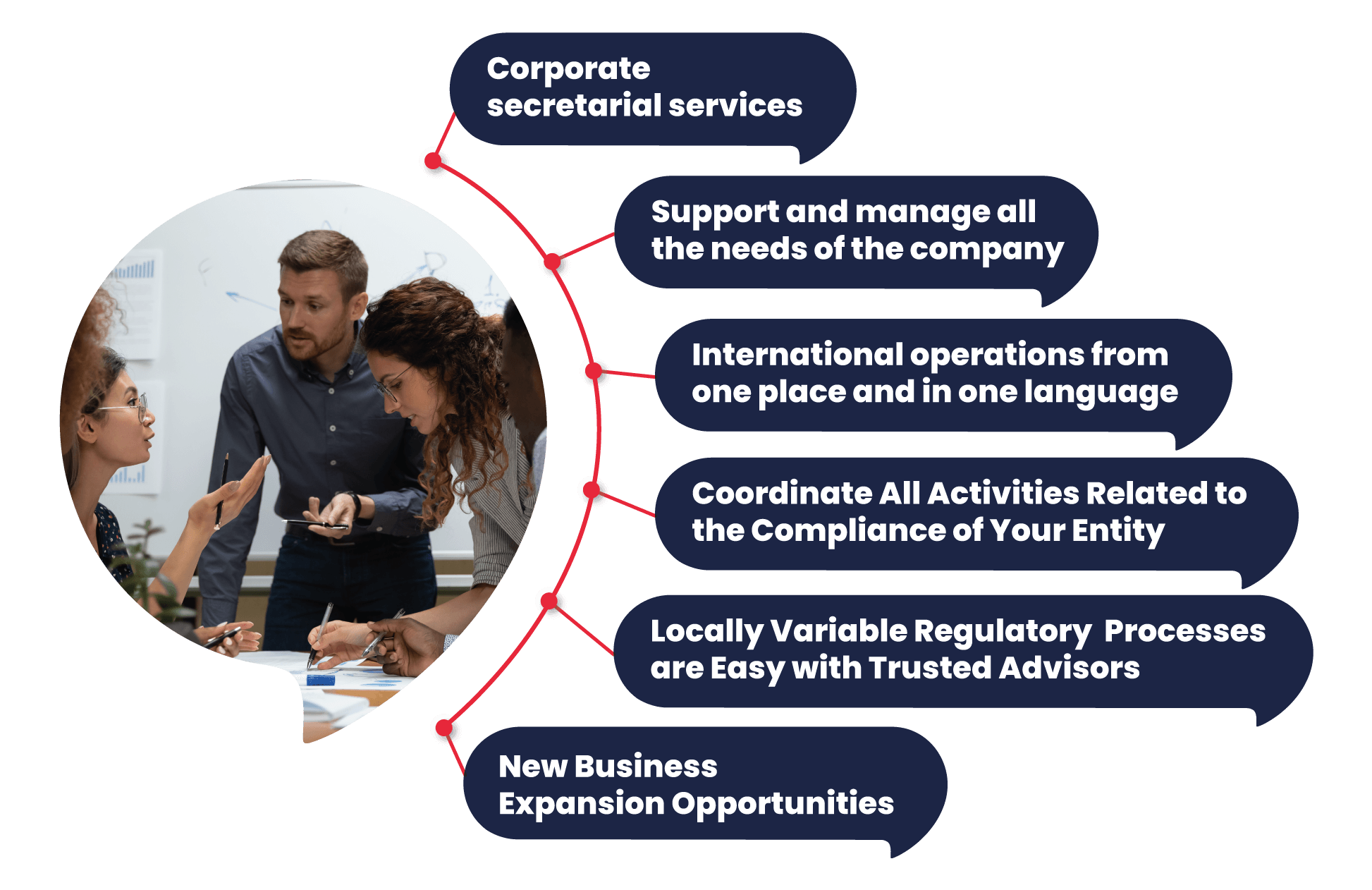
International corporate secretarial services
Our corporate secretarial services meet the most demanding needs of international companies. We assist you through the challenges multinational companies face by easing your compliance burden and allowing you to focus on running your business.
Global Entity Incorporation
Providing an integral solution for entry and operations within international markets
Read More
Global Director
Services
Support to handle all your commercial, administrative, and banking necessities
Read More
Global Document
Retrieval
Documents available through our network of experts make the process faster and more reliable
Read More
Why choose H&CO
Entity Management Service?
H&CO offers comprehensive global corporate compliance management through Entity Management.
Our multidisciplinary approach integrates tax, consulting, accounting, and financial advisory to deliver streamlined, cost-effective services.
With expertise in complex compliance and value-added services, we ensure consistent global coordination across 16+ countries to guide your project efficiently.
FAQs about Entity Management Service
-
What is Entity Management and why does my business need it?
Entity Management is the suite of services responsible for incorporating, maintaining, and managing a company’s legal compliance across one or multiple jurisdictions. It ensures your business remains active and in good standing with relevant authorities. This includes everything from initial incorporation to ongoing requirements, such as:
- Maintaining a registered office address in each jurisdiction of operation.
- Filing annual reports, tax returns, and renewals with regulatory agencies.
- Appointing a corporate administrator to receive legal and government notices.
- Coordinating structural changes (directors, shareholders, addresses) and reporting them appropriately.
Why do you need it? Failing to meet these obligations—even by oversight—can result in fines, loss of good standing, or administrative dissolution. For companies operating in multiple countries, complexity grows exponentially due to differing deadlines, forms, and local regulations. Delegating this to specialists becomes a strategic necessity rather than just an administrative task.
-
What is a Registered Agent and is it mandatory?
A Registered Agent is an individual or entity officially designated to receive legal documents, lawsuits, and official government correspondence on behalf of a company.
Whether it is mandatory depends on the country and local laws:
- United States: Almost all states require LLCs and corporations to designate a registered agent with a valid physical address (no P.O. boxes) available during regular business hours.
- Mexico: The equivalent role is the Representante Legal Local (Local Legal Representative), which carries broader obligations.
- Costa Rica: Both roles coexist with distinct responsibilities.
Why companies hire a professional Registered Agent instead of acting as their own:
- Privacy: Prevents the owner’s home or personal address from being exposed in public records.
- Continuity: Ensures someone is always available to receive critical documents, even if the business owner travels or relocates.
- Penalty Prevention: Professional agents track deadlines and annual filings, reducing the risk of missed notices that lead to fines or dissolution.
- Scalability: If your business expands to multiple states or countries, a single provider can centralize the role across all jurisdictions.
-
What is a Company in Good Standing and How Do You Maintain It?
In legal and financial contexts, Good Standing (or a Certificate of Status/Compliance) confirms that an entity is properly registered, active, and fully up to date with its obligations before the local commercial registry or tax authority.
This certificate proves the company has filed its annual reports, paid its taxes, and faces no pending dissolution or government sanctions. A Certificate of Good Standing is essential for opening corporate bank accounts, attracting investors, signing international commercial contracts, or registering new branches.
Key Pillars to Maintain Corporate Compliance
To guarantee operational continuity globally, businesses must follow four core pillars:
- Mandatory Reporting: Submitting annual reports, financial statements, or activity disclosures within local statutory deadlines.
- Government Fees and Taxes: Timely payment of corporate taxes, franchise taxes, or registry renewal fees.
- Updated Records: Keeping legal addresses, director details, and beneficial ownership information accurate following any structural changes.
- Centralized Calendar Management: Proactively tracking deadlines—a critical factor for corporations operating across different time zones, regulations, and languages.
The Impact of Non-Compliance: Losing your corporate status exposes the business to immediate financial penalties and can freeze commercial operations. Financial institutions and business partners regularly verify this status before doing business.
-
What are the steps to incorporate a business in another country or state?
Incorporating an entity in a foreign jurisdiction varies significantly by location, but generally follows this sequence:
- Select the Legal Structure: Choosing the right entity type (LLC, Corporation, branch, etc.) based on your business activity, desired liability protection, and tax implications.
- Choose the Jurisdiction: Selecting the specific state or province, as significant differences in costs, timelines, and tax benefits often exist within the same country.
- Appoint a Registered Agent/Legal Representative and establish a legal corporate address within the jurisdiction.
- File Incorporation Documents (Articles of Organization or Incorporation) with the corresponding authority and pay the required filing fees.
- Obtain Tax IDs (such as an EIN in the U.S.) and open corporate bank accounts.
- Fulfill Additional Registrations, including local business licenses, industry-specific permits, and registrations with tax authorities.
Timeline dependencies include client-side factors (notarizing and apostilling documents) and authority review times. While incorporation can be fast, becoming fully operational—setting up accounting, taxes, and payroll—depends heavily on the jurisdiction. Language barriers and shifting local costs make expert guidance essential to avoid operational delays.
-
What happens if my company fails to meet corporate obligations or file annual reports?
Missing compliance deadlines, failing to pay local fees, or lacking a registered agent can trigger severe consequences:
- Financial Penalties: In most jurisdictions, fines accumulate over time, directly impacting your bottom line.
- Loss of Good Standing: This halts critical processes like opening or maintaining bank accounts, securing financing, or signing contracts with third parties who require proof of compliance.
- Administrative Suspension: The entity temporarily loses its legal authorization to operate until its status is regularized with the authorities.
- Administrative Dissolution: The most severe outcome. The authority formally cancels the company's legal existence, forcing it into a costly reinstatement process or requiring the creation of an entirely new company.
Beyond the legal impact, non-compliance erodes trust with partners, investors, and clients. Maintaining an updated compliance calendar—or outsourcing it to a specialized provider—is the most effective preventive measure.
-
What is included in H&CO’s Entity Management service?
H&CO’s Entity Management service provides comprehensive global corporate compliance management by combining a multidisciplinary approach with integrated tax and accounting solutions under one roof. Our core services include:
- Global Entity Incorporation: End-to-end guidance for entering and operating in international markets, from entity selection to document filing.
- Dedicated Corporate Administrator: A designated specialist to manage your corporate obligations, backed by expertise in multi-jurisdictional structuring and complex compliance.
- Registered Office & Mail Forwarding: A physical address across multiple jurisdictions to satisfy public registry mandates, coupled with secure mail handling.
- Ongoing Corporate Maintenance: Monitoring federal, state, and local requirements to keep your entity compliant and prevent penalties or cancellations.
- Global Director & Document Retrieval Services: Administrative, banking, and documentary support across various jurisdictions.
- Accounting: Complete tracking of financial transactions under local and international standards (such as US GAAP/IFRS), financial statement preparation, bank reconciliations, and ledger maintenance.
- Taxes: Planning, calculating, and filing corporate tax returns locally and cross-border, ensuring full compliance, tax optimization, and audit prevention.
- Payroll: Full-cycle employee payroll management, including salary calculations, tax withholdings, social security contributions, and local benefit compliance.
H&CO ensures consistent global coordination across more than 30 countries and over 100 locations through our network of strategic allies and subcontractors. This allows multinational companies to centralize corporate compliance with a single point of contact.
-
Why choose H&CO for entity management instead of a traditional registered agent or managing it internally?
Traditional registered agents often limit their scope to receiving and forwarding legal documents. H&CO offers an integrated approach that pairs compliance management with deep accounting, tax, and financial expertise. This is particularly valuable for businesses operating in multiple countries.
Key advantages over internal management or fragmented local providers include:
- Centralized Coordination: We manage compliance across more than 30 countries, eliminating the need to hire and supervise separate vendors in every market.
- Decades of Corporate Experience: International corporate expertise backed by the BDO Alliance USA network, providing long-term credibility with banks, investors, and regulators.
- Multidisciplinary Vision: The same team managing your compliance understands international taxation, accounting, and asset structuring, allowing us to anticipate legal and tax implications that a traditional agent might miss.
- Risk Reduction: By delegating deadline tracking, reporting, and renewals to specialists, we free up your executive team to focus on business growth rather than compliance administration.
For companies expanding to new markets or struggling to manage multiple jurisdictions internally, partnering with H&CO provides the specialized support needed to scale smoothly without administrative friction.